utkarsh_logo
Edit Content
Click on the Edit Content button to edit/add the content.

VEDIC MATHS

What is Vedic Maths ?

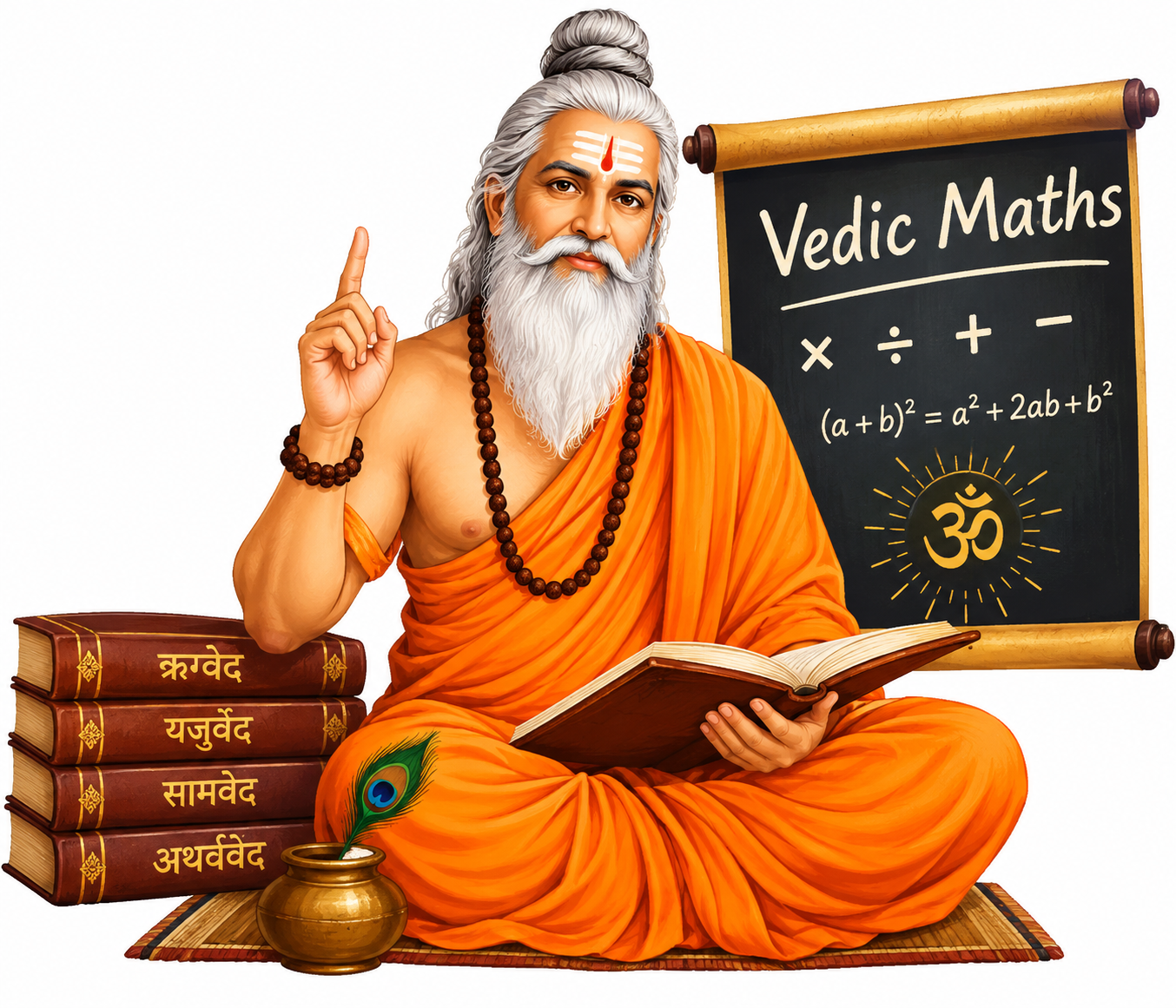
Vedic Maths is an ancient system of mathematics that originated in India, based on techniques and principles derived from the Vedas (ancient Indian scriptures). Vedic Maths is an ancient system of mathematics that originated in India and is based on principles and techniques derived from the Vedas, particularly the Atharva Veda. Rediscovered in the 20th century by Bharati Krishna Tirthaji Maharaj, this system uses 16 sutras (aphorisms) and several sub-sutras to providesimple, faster, and more efficient methods for solving mathematical problems compared to conventional methods. It emphasizes mental calculation, pattern recognition, and flexible approaches to arithmetic, algebra, geometry, and more. Vedic Maths enables learners to perform complex calculations quickly, enhances concentration, memory, and problem-solving skills, and builds confidence in handling numbers. Its versatility makes it applicable for daily calculations, competitive exams, and academic learning, all while making math more enjoyable and less intimidating.
vedic maths2

Key features of Vedic Mathematics

The system is based on 16 sutras (aphorisms) and 13 sub-sutras that provide a framework for performing mathematical operations.

Mental Calculation Techniques are methods of performing arithmetic quickly and accurately using only the mind. These techniques enhance students’ logical thinking, memory, and problem-solving speed.

Techniques can be applied to arithmetic, algebra, geometry, trigonometry, calculus, and more.

Practicing Vedic Maths enhances mental agility, concentration, and mathematical aptitude.

While widely used in educational settings and mental math practice, its methods remain debated among mathematicians.

The benefits of Vedic Maths

  • Enhanced Mental Calculation Skills: Enables quick and accurate calculations using mental techniques.
  • Improved Problem-Solving Abilities: Helps break down complex problems into simpler steps for easier solutions.
  • Flexibility and Versatility: Techniques apply to arithmetic, algebra, geometry, calculus, and more.
  • Increased Speed and Accuracy: Enhances calculation speed while reducing errors.
  • Simplified Learning Process: Easy-to-learn techniques suitable for all ages and skill levels.
  • Cultural and Historical Connection: Rooted in Indian heritage and inspired by ancient Vedic scriptures.
  • Enhanced Memory and Concentration: Mental practice improves focus, retention, and cognitive skills.
  • Applicability in Competitive Exams: Useful for faster calculations and problem-solving under timed conditions.
  • Boosted Confidence: Mastery of techniques encourages a positive attitude towards mathematics.
  • Transferable Skills: Skills gained are applicable in academics, professional life, and daily calculations.